A housing loan Singapore buyers apply for generally falls into one of two categories: an HDB loan or a bank loan, and choosing between them can significantly affect your monthly repayments and long-term costs. With different eligibility rules, interest structures, and down payment requirements, it’s easy to feel overwhelmed if you’re comparing options for the first time.
This guide, brought to you by FinanceGuru, breaks down everything you need to know about a housing loan in Singapore from interest rates and eligibility to refinancing and foreigner financing, so you can choose the right path for your property purchase.
What Is a Housing Loan in Singapore?
A housing loan in Singapore is financing used to purchase residential property, whether an HDB flat, an Executive Condominium (EC), or private property. Repayment typically spans 25 to 30 years, with the property serving as collateral throughout the loan tenure.
Unlike some countries where a single mortgage system applies to all property types, a housing loan Singapore applicant takes out can come from two very different sources: the HDB itself, or a participating bank.
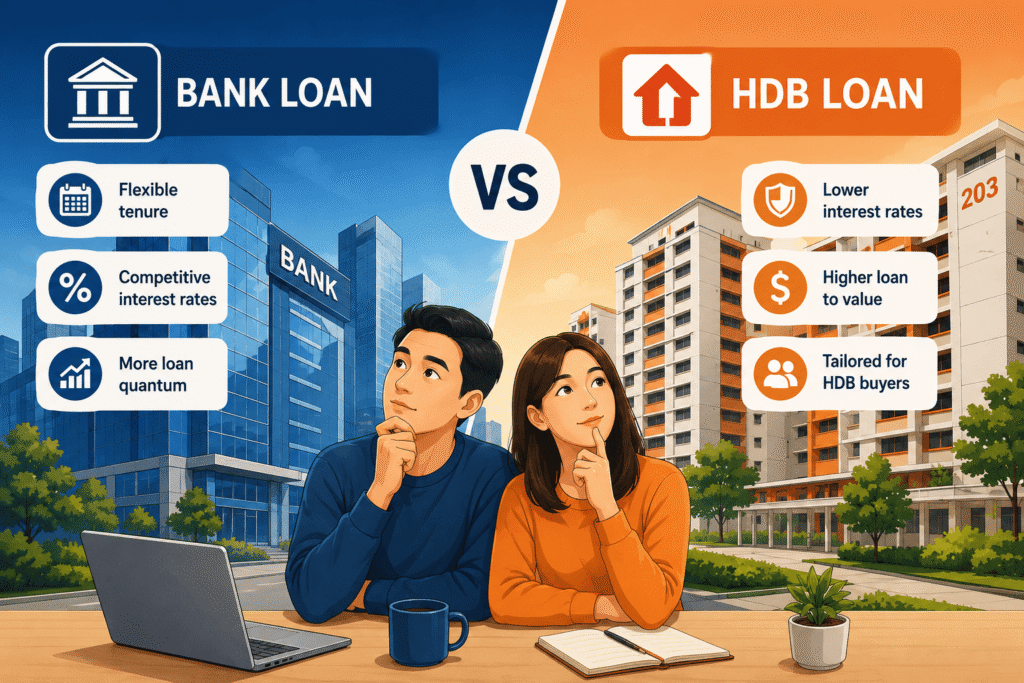
HDB Housing Loan Singapore vs Bank Loan: Key Differences
Understanding the HDB housing loan Singapore offers versus a bank loan is the first step in making the right choice.
HDB Housing Loan
● Requires only 25% down payment (cash or CPF)
● Interest rate pegged to the CPF Ordinary Account rate + spread of 0.1%
● Simpler income assessment criteria
● Only applicable to HDB flats
Bank Loan
● Minimum 5% cash down payment required
● Offers both fixed and floating rate packages
● Rates are often more competitive during low interest-rate periods
● Applicable to HDB flats, ECs, and private properties
When comparing bank loan vs HDB loan Singapore options, the decision usually comes down to your risk tolerance. HDB loans offer stability, while bank loans can offer lower rates but come with more market exposure. Our Home Loans page lists current bank packages if you’d like to compare real numbers side by side.
Housing Loan Eligibility Singapore Requirements
Housing loan eligibility Singapore authorities set depends on which loan type you’re applying for.
For HDB Loans
● At least one applicant must be a Singapore Citizen
● Household income ceiling applies (currently $14,000 for families, $21,000 for extended families)
● Applicants must not own other property at the time of application
● Must not have taken more than two previous HDB loans
For Bank Loans
● Open to Singapore Citizens, Permanent Residents, and eligible foreigners
● No fixed income ceiling, but subject to Total Debt Servicing Ratio (TDSR) and Mortgage Servicing Ratio (MSR) limits
● Loan-to-Value (LTV) limits apply, generally up to 75% for a first property loan
These Singapore housing loan requirements determine not just whether you qualify for a housing loan Singapore banks approve, but how much you can ultimately borrow.
Housing Loan Interest Rate Singapore: What Affects It
The housing loan interest rate Singapore lenders offer is shaped by several factors, including the Singapore Overnight Rate Average (SORA), each bank’s cost of funds, and prevailing market competition.
Fixed vs Floating Rates
● Fixed-rate packages lock your rate for 2 to 5 years, offering predictability at a slightly higher starting cost.
● Floating-rate packages move with SORA, which can mean lower costs during rate downturns but added uncertainty when rates rise.
Example: A borrower financing a $500,000 flat might choose a fixed rate for peace of mind during the first few years of ownership, then reassess once the lock-in period ends and market conditions shift.
Housing Loan for Foreigners in Singapore
A housing loan for foreigners in Singapore differs from housing loans available to citizens and PRs in a few important ways:
● Foreigners are not eligible for HDB loans and can only apply through banks
● LTV limits and down payment requirements are typically stricter
● Interest rates may be slightly higher depending on the bank’s risk assessment
● Additional Buyer’s Stamp Duty (ABSD) applies and significantly affects total cost
Foreign buyers should factor in these additional costs early, as they can substantially change the overall affordability of a purchase.
Private Property Housing Loan Singapore Options
If you’re purchasing a condominium or landed property, a private property housing loan Singapore application only goes through banks, since HDB loans are exclusive to HDB flats.
Key considerations for private property financing include:
● Larger loan quantums, which make comparing effective interest rates even more important
● Executive Condominiums (ECs) follow private property loan rules once they cross the 10-year mark
● Legal and valuation subsidies vary more widely between banks for higher-value properties
Because private property loans often involve larger sums, even a small rate difference can translate into significant savings or costs over the loan tenure. You can explore more in our Private and Landed Property Guide in Singapore for additional considerations specific to landed property.
How to Use a Housing Loan Calculator Singapore Tool
Before committing to any housing loan Singapore package, using a housing loan calculator Singapore tool helps you estimate:
● Monthly instalments based on loan amount, tenure, and interest rate
● Total interest payable over the full loan period
● How different rate scenarios (fixed vs floating) affect your budget
● Whether your income comfortably meets TDSR and MSR requirements
Running these numbers before house-hunting prevents the common mistake of falling in love with a property that doesn’t fit your actual borrowing capacity.
Finding the Best Housing Loan Package Singapore Has to Offer
Identifying the best housing loan package Singapore banks currently offer requires looking beyond the headline rate:
1. Compare the effective interest rate, not just the promotional first-year figure
2. Check the lock-in period and any penalties for early repayment
3. Ask about subsidies for legal fees, valuation, and fire insurance
4. Confirm conversion flexibility in case you want to switch rate structures later
5. Review the bank’s service track record, especially for disbursement timelines
Comparing multiple banks manually takes time, which is why many buyers work with an advisory service that already tracks current packages across the market.
When Housing Loan Refinancing in Singapore Makes Sense
Your first loan doesn’t have to be your last. Housing loan refinancing in Singapore for homeowners is worth considering when:
● Your lock-in period has ended
● Market interest rates have dropped since you signed your original loan
● Your financial goals or property plans have changed
● You want to shorten your loan tenure to save on total interest
Reviewing your housing loan Singapore package every two to three years, or right before your lock-in ends, is one of the simplest ways to keep your repayments competitive. Our Home Loan Singapore: The Complete 2026 Guide covers refinancing timing and current bank packages in more depth.
Common Mistakes to Avoid
● Comparing only the first-year rate instead of the effective rate over the full tenure
● Overlooking eligibility rules before applying, especially for HDB loans
● Not using a housing loan calculator Singapore tool to check affordability upfront
● Ignoring refinancing opportunities once the lock-in period ends
● Underestimating additional costs like ABSD for foreign buyers or legal fees
Frequently Asked Questions
1. What is the main difference between an HDB loan and a bank loan? An HDB loan offers a rate pegged to the CPF Ordinary Account rate, plus a spread of 0.1%,while a bank loan offers more package variety and potentially lower rates but requires at least 5% cash upfront.
2. Can foreigners get a housing loan in Singapore? Yes, foreigners can apply for a housing loan in Singapore through banks, though HDB loans are not available to them, and Additional Buyer’s Stamp Duty applies.
3. What documents are needed for housing loan eligibility in Singapore? Typically, proof of income (payslips or Notice of Assessment), identification documents, and details of any existing property or loans are required for assessment.
4. How much can I borrow for a housing loan in Singapore? This depends on your income, existing debt obligations under TDSR/MSR, and current LTV limits, generally up to 75% of the property’s value for a first bank loan.
5. Is it worth refinancing a housing loan in Singapore? Yes, especially if your lock-in period has ended and current rates are meaningfully lower than your existing package, since even a small rate reduction can save significantly over a 25 to 30-year tenure.
Final Thoughts
Choosing the right housing loan Singapore banks or HDB can offer comes down to understanding your eligibility, comparing interest rate structures, and reviewing your package regularly rather than treating your first loan as a permanent decision. Whether you’re applying for an HDB loan, a bank loan, or refinancing an existing housing loan in Singapore, taking the time to compare options properly can save you thousands of dollars over your loan tenure.
Need help comparing housing loan options in Singapore for your situation? Get a free, no-obligation consultation with FinanceGuru and let our specialists compare packages across 16 banks on your behalf.
GET YOUR FREE HOUSING LOAN ASSESSMENT →
FinanceGuru
12 Arumugam Road, #02-02B
LTC Building, Suite B,
Singapore 409958
Phone: +65 9890 9090