Moving from an HDB flat to a condominium or landed property is a significant financial step, and one of the first things upgraders discover is that a private property loan in Singapore works quite differently from the HDB financing they are used to. The down payment structure, eligibility rules, and interest rate options all shift once you move out of the HDB financing system.
This guide breaks down exactly how a private property loan in Singapore compares to HDB financing, covering down payments, LTV private property Singapore limits, TDSR private property loan requirements, and how to decide between a bank loan for private property Singapore and staying within the HDB system.
Why a Private Property Loan in Singapore Works Differently
A private property loan in Singapore is only available through commercial banks, unlike HDB flats, which can be financed through either an HDB loan or a bank loan. This single difference cascades into nearly every other aspect of the loan.
Because private property loans are bank-only, there is no fixed concessionary rate pegged to the CPF Ordinary Account rate, as there is with HDB financing. Instead, every bank sets its own fixed, floating, or hybrid rate packages, which means a private property loan in Singapore requires more active comparison shopping than an HDB purchase does. Our home loan advisory service works across multiple banks specifically to make this comparison manageable for buyers.
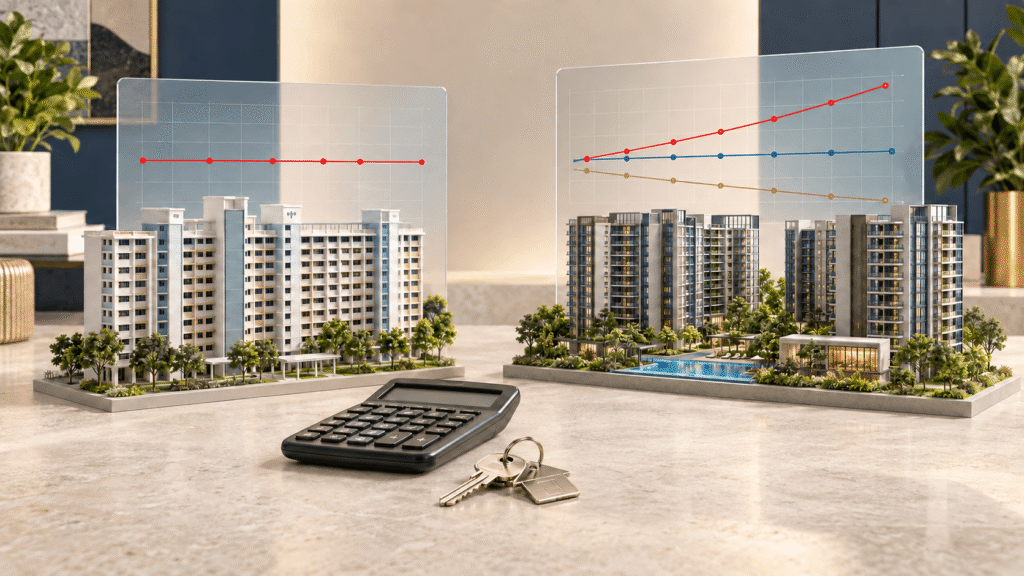
Private Property Loan vs HDB Loan: The Core Differences
Understanding private property loan vs HDB loan differences upfront prevents unpleasant surprises during the application process.
Down payment. HDB financing through an HDB loan requires a 25 percent down payment, which can typically be paid in full through CPF with no mandatory cash component. A private property loan in Singapore requires a minimum of 25 percent down payment, of which at least 5 percent must be in cash, with the remainder payable via CPF or cash.
Loan source. HDB financing offers a choice between the HDB loan and a bank loan. A private property loan in Singapore is exclusively bank-financed, since HDB loans do not extend to condominiums or landed property.
Interest rate structure. HDB loans carry a fixed concessionary rate. A private property loan in Singapore is priced using fixed, floating (SORA-pegged), or hybrid packages that vary by bank and change with market conditions.
Eligibility. HDB financing has income ceiling restrictions tied to flat eligibility schemes. A private property loan in Singapore has no income ceiling, but is instead governed by TDSR and credit assessment criteria.
For a deeper look at how HDB buyers weigh their own bank loan versus HDB loan decision before ever reaching the private market, our article on bank loan vs HDB loan options is a useful companion read.
LTV Private Property Singapore: How Much You Can Borrow
The LTV private property Singapore limit determines your maximum loan quantum relative to the property’s purchase price or valuation, whichever is lower.
The current tiers are:
1. First property loan, no outstanding home loans — up to 75 percent LTV, requiring a 25 percent down payment
2. Second property loan — up to 45 percent LTV, requiring a 55 percent down payment, of which at least 25 percent must be cash
3. Third or subsequent property loan — up to 35 percent LTV, requiring a 65 percent down payment, of which at least 25 percent must be cash
Buyers with an existing HDB flat who are upgrading, rather than selling first, should check their specific LTV private property Singapore entitlement carefully, since taking on a private property loan while still holding an HDB mortgage counts as an additional outstanding loan and triggers the lower LTV tiers.
Additionally, if the loan tenure exceeds 30 years, or extends past age 65 at maturity, the LTV private property Singapore limit is reduced further, meaning older borrowers or those seeking very long tenures may need a larger cash down payment to compensate.
TDSR Private Property Loan Requirements
Every TDSR private property loan application is assessed against the Total Debt Servicing Ratio, which caps total monthly debt obligations, including the new mortgage, car loans, credit card minimums, and any other liabilities, at 55 percent of gross monthly income.
Unlike HDB financing, which is also subject to the Mortgage Servicing Ratio capping housing repayments at 30 percent of income, a TDSR private property loan is not subject to the MSR. This means private property buyers can, in some cases, allocate a larger share of their income toward mortgage repayments than HDB buyers, provided they still satisfy the 55 percent TDSR ceiling.
For upgraders who still have an existing HDB mortgage while applying for a TDSR private property loan, banks will factor in the existing loan’s monthly repayment when calculating overall debt obligations. This is a common reason upgraders find their private property loan quantum smaller than expected, particularly if they have not yet sold their HDB flat.
Choosing a Bank Loan for Private Property Singapore
Since a bank loan for private property in Singapore is your only financing route, the package comparison process deserves close attention. Key factors to evaluate include:
1. Interest rate type — fixed for payment certainty, floating for potential savings if SORA remains low, or hybrid for a blend of both
2. Lock-in period — typically two to five years, during which early redemption triggers a penalty of around 1.5 percent of the outstanding amount
3. Legal fee subsidies — many banks offer subsidised legal fees for a bank loan for private property in Singapore above a certain quantum.
4. Conversion flexibility — whether the package allows switching between rate types without a full refinance
Comparing at least three banks’ offers for a bank loan for private property in Singapore, rather than accepting the first pre-approval, often uncovers better terms meaningfully, particularly on legal fee subsidies and lock-in flexibility. You can start comparing options through our home loan application form.
Additional Costs Upgraders Should Plan For
Beyond the private property loan in Singapore itself, upgraders should budget for:
● Buyer’s Stamp Duty (BSD), calculated on a tiered basis against the purchase price
● Additional Buyer’s Stamp Duty (ABSD), which applies if the HDB flat has not yet been sold at the point of purchasing the private property
● Valuation and legal fees, some of which may be subsidised
depending on the bank loan for the private property Singapore package selected
Factoring these costs in early, alongside the LTV private property Singapore limits and TDSR private property loan calculation, gives a realistic total budget rather than one based on the loan amount alone. Our 2026 home loan guide covers current rate benchmarks that feed directly into this budgeting exercise.
Frequently Asked Questions
Can I use an HDB loan to buy a private property?
No. HDB financing is only available for HDB flats. A private property loan in Singapore must be obtained through a commercial bank.
What is the minimum down payment for a private property loan in Singapore?
A minimum of 25 percent for a first property loan, with at least 5 percent required in cash and the remainder payable via CPF or cash.
Does TDSR apply differently to private property compared to HDB flats?
TDSR applies to both, capping total debt obligations at 55 percent of gross income. However, private property loans are not additionally subject to MSR, which does apply to HDB and EC purchases.
How does having an existing HDB loan affect my eligibility for a private property loan?
Your existing HDB mortgage repayment is factored into your TDSR calculation when taking on a private property loan. At the same time, it remains outstanding and also places you in a lower LTV tier, which can reduce the loan quantum available until the HDB flat is sold.
Is the LTV limit the same for a first and second property?
No. The LTV private property Singapore limit is 75 percent for a first property loan, dropping to 45 percent for a second and 35 percent for a third or subsequent property loan.
Ready to compare private property loan packages in Singapore tailored to your upgrading timeline? Get a free, no-obligation loan comparison from FinanceGuru’s advisory team.
FinanceGuru
12 Arumugam Road, #02-02B
LTC Building, Suite B,
Singapore S409958
Contact: +65 9890 9090